Protect Your Bones: How to Give Your Bones the Stimulus and Nutrition They Need
PLEASE NOTE: My goal is to help you better understand your body through education. The information shared in these Q&A articles is for informational purposes only and should not replace advice from your physician or other qualified healthcare provider. As research continues to grow, recommendations and scientific understanding may change over time. I encourage you to do your own research, ask questions, and work with a healthcare professional to determine what's best for your unique situation.
Give your bones the stimulus and nutrition they need.
Your bones carry you through every part of your life — every step, every hug, every trip up the stairs. They quietly hold you up, and most of the time, you never have to think about them.
After menopause, they deserve a little more of your attention. The good part is that so much of what keeps bones strong is within your reach: how you move, what you eat, and the small daily choices you make. This guide gathers it all in one place, step by step, so you can take ownership of your bone health and build habits that protect you for decades to come.
What Your Bones Need
Bones are living tissue. Throughout your life, your body breaks down old bone and builds new bone to replace it. [1] After menopause, the drop in estrogen tips that balance toward breakdown, and women can lose up to 20% of their bone density in the five to seven years after menopause. [1][2]
To keep the building side strong, your bones need two things:
Stimulus. Bones respond to the forces placed on them. When your muscles pull on your bones and your feet meet the ground, your body gets the message to keep bone strong.
Nutrition. Bones need raw materials to rebuild — calcium, vitamin D, protein, and a team of supporting nutrients from whole foods.
The steps below cover both. You don't have to do them all at once. Pick one or two to start, build them into your routine, and add more over time.
Part One: Give Your Bones a Reason to Stay Strong
Step 1: Load Your Bones With Strength Training
Strength training is one of the most powerful signals you can send your bones. Exercise slows the loss of both muscle and bone and helps build stronger bones. [3]
In the LIFTMOR study, post-menopausal women with low bone density did supervised strength and impact training twice a week, for 30 minutes at a time, over eight months. They improved bone density at the spine and hip, along with their physical function. [4]
How to put it into practice:
Train at least twice a week. Short sessions count — 20 to 30 minutes is enough.
Focus on movements that load your hips and spine: squats or chair stands, hip hinges (like deadlifts or picking a weight up from the floor with a flat back), step-ups, and lunges.
Include your upper body and back: rows, wall or counter push-ups, and carrying heavy bags or weights. A strong upper back supports good posture.
Make it challenging. Bones respond best when the work feels hard by the last few repetitions. Build up gradually as you get stronger.
The Protect Your Strength guide in this series walks through these movements step by step — the same routine that builds muscle also builds bone.
Step 2: Add Gentle Impact
Bones also respond to quick, jolting forces — the kind that travel up through your body when your feet meet the ground. Researchers at Manchester Metropolitan University found that simple jumping exercises can help post-menopausal women's bone health, and noted that walking alone is often not enough. [5]
They tested several moves in early post-menopausal women and suggested 30 jumps, three times a week — about six minutes of total work in a whole week. Jumps created the strongest effect, while heel drops and small step-down drops also helped. [5][6]
Start gentle and build up:
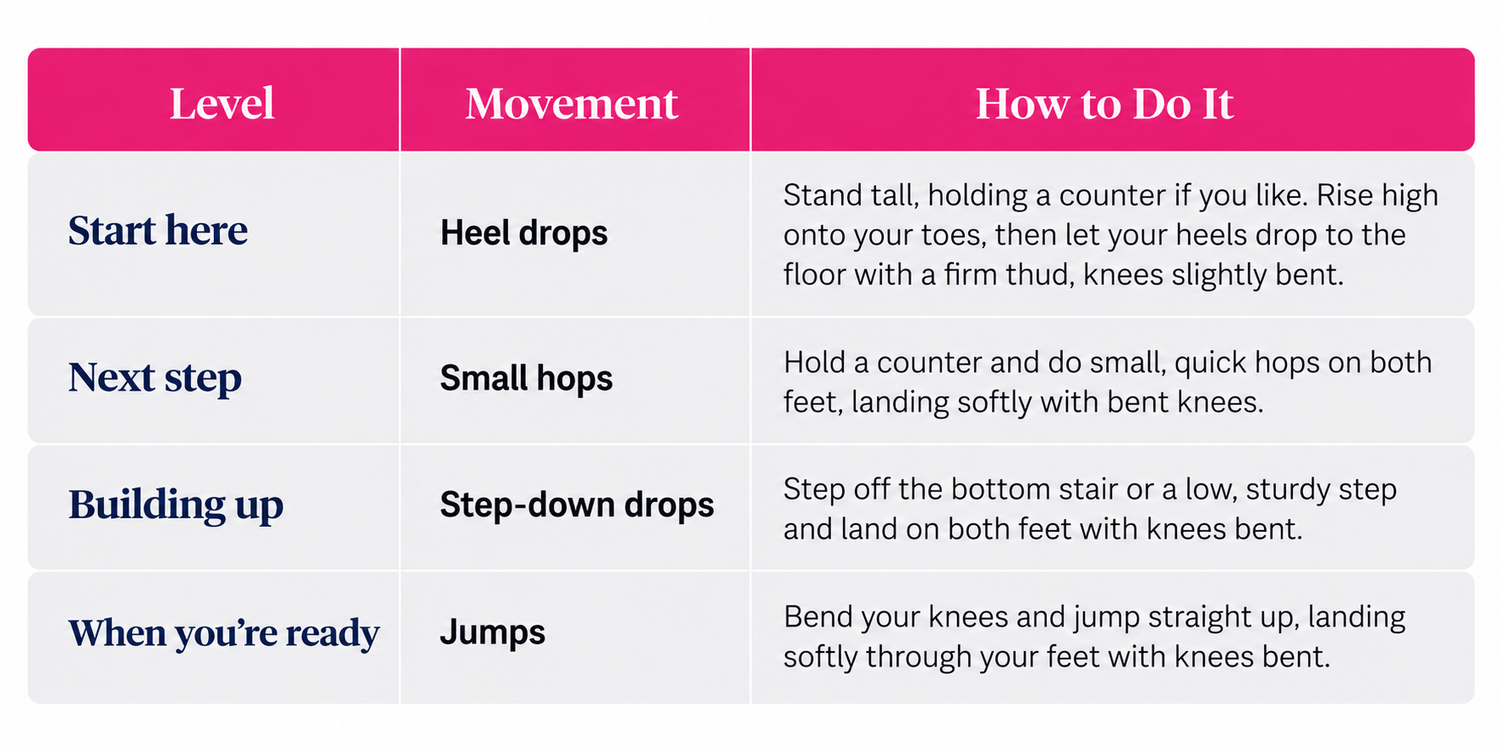
Spread your reps out through the day if you like — 10 in the morning, 10 at lunch, 10 in the evening. Do whatever makes it easiest to stay consistent.
A Note About Exercise Safety
Not every exercise is right for every body, and that's especially important when it comes to bone health. If you've been diagnosed with osteoporosis, experienced a fracture from a minor fall, or have been told you're at higher risk for fractures, talk with your healthcare provider or a physical therapist familiar with osteoporosis before beginning jumping, heel drops, or other high-impact exercises.
The goal isn't to push harder. It's to find safe, appropriate ways to challenge your bones and muscles while building strength and confidence over time.
Step 3: Stay on Your Feet and Protect Your Balance
Strong bones matter most when you avoid the falls that break them. Regular exercise lowers the risk of falls and serious injuries like hip and wrist fractures. [3]
Daily weight-bearing movement: Walking, hiking, dancing, gardening, pickleball, and climbing stairs all keep your bones working against gravity. Walking alone may not be enough to build bone [5], but it's a wonderful daily foundation to pair with strength and impact work.
Balance practice (a few minutes most days):
Stand on one foot while brushing your teeth or waiting for the kettle, holding the counter if needed
Walk heel to toe down a hallway
Try tai chi or a gentle yoga class focused on balance
Posture care: Stand tall, keep your shoulders gently back, and strengthen your upper back with rows and band pull-aparts. When lifting, bend at your hips and knees and keep your back flat, rather than rounding your spine.
Fall-proof your home:
Add good lighting, especially on stairs and between the bedroom and bathroom
Secure or remove loose rugs and clear cords from walkways
Install handrails on stairs and grab bars in the shower
Wear supportive, non-slip shoes around the house
Part Two: Nourish Your Bones
Step 4: Build a Bone-Nourishing Plate With Calcium
Calcium is the main mineral in bone. Women 51 and older are advised to get 1,200 mg of calcium a day. [7] Food is the best place to start — it comes packaged with other nutrients your bones need, too.
Calcium-rich foods (amounts are approximate and vary by brand — check labels):
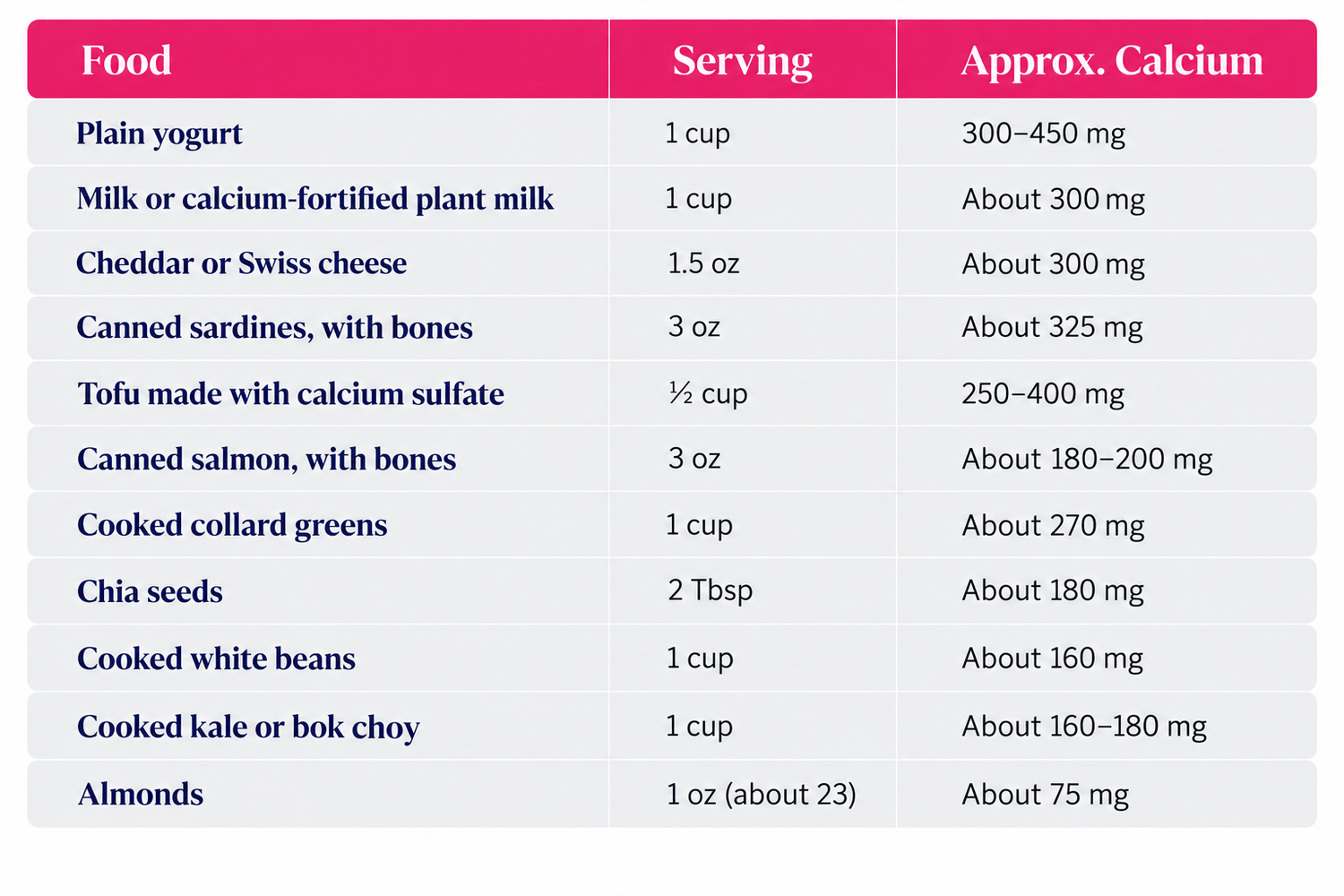
Simple ways to reach your goal:
Include a calcium-rich food at each meal, rather than trying to get it all at once — your body absorbs calcium better in smaller amounts.
Add yogurt or kefir to breakfast, cheese or sardines to lunch, and leafy greens or calcium-set tofu to dinner.
If you don't eat dairy, lean on fortified plant milks, calcium-set tofu, canned fish with bones, leafy greens, beans, and seeds.
Step 5: Get Your Vitamin D (and Some Sunshine)
Vitamin D helps your body absorb the calcium you eat. Without enough of it, even a calcium-rich diet can't do its full job. The recommended amount is 600 IU a day up to age 70, and 800 IU after that. [7]
Where to find it:
Sunlight. Your skin makes vitamin D when sunlight reaches it. Short, regular time outdoors — a morning walk, gardening, sitting on the porch — helps. How much you make depends on your skin tone, the season, where you live, and the time of day, and many people make very little in winter.
Fatty fish: salmon, trout, sardines, and mackerel
Egg yolks
Fortified foods: many milks, plant milks, yogurts, and cereals have vitamin D added
UV-exposed mushrooms: some mushrooms are grown under UV light to boost their vitamin D — check the label
Time outdoors does double duty: a walk in the sunshine gives you weight-bearing movement, vitamin D, fresh air, and a calmer nervous system all at once.
Step 6: Eat Enough Protein — Alongside Your Calcium
You may have heard that protein pulls calcium from your bones. The research doesn't support that worry. An expert review endorsed by the International Osteoporosis Foundation found that in older adults, protein intakes even above the standard recommendation are linked with higher bone density, slower bone loss, and lower hip fracture risk — as long as calcium intake is adequate. [8] The same review noted that eating too little protein is likely a bigger problem for older adults than eating too much. [8]
How to put it into practice:
Include protein at every meal — a palm-sized portion or more.
Pair protein with calcium where you can: Greek yogurt, cottage cheese, sardines or salmon with bones, calcium-set tofu, or a glass of milk with a meal.
Mix animal and plant proteins — eggs, fish, poultry, dairy, beans, lentils, tofu, nuts, and seeds all count.
Protein supports your muscles, too, and stronger muscles mean more pull on your bones and better protection from falls.
Step 7: Fill In the Supporting Nutrients From Whole Foods
Calcium and vitamin D get the most attention, but bones rely on a whole team of nutrients. Magnesium and vitamin K both play real roles in how bone is built and maintained. [9]
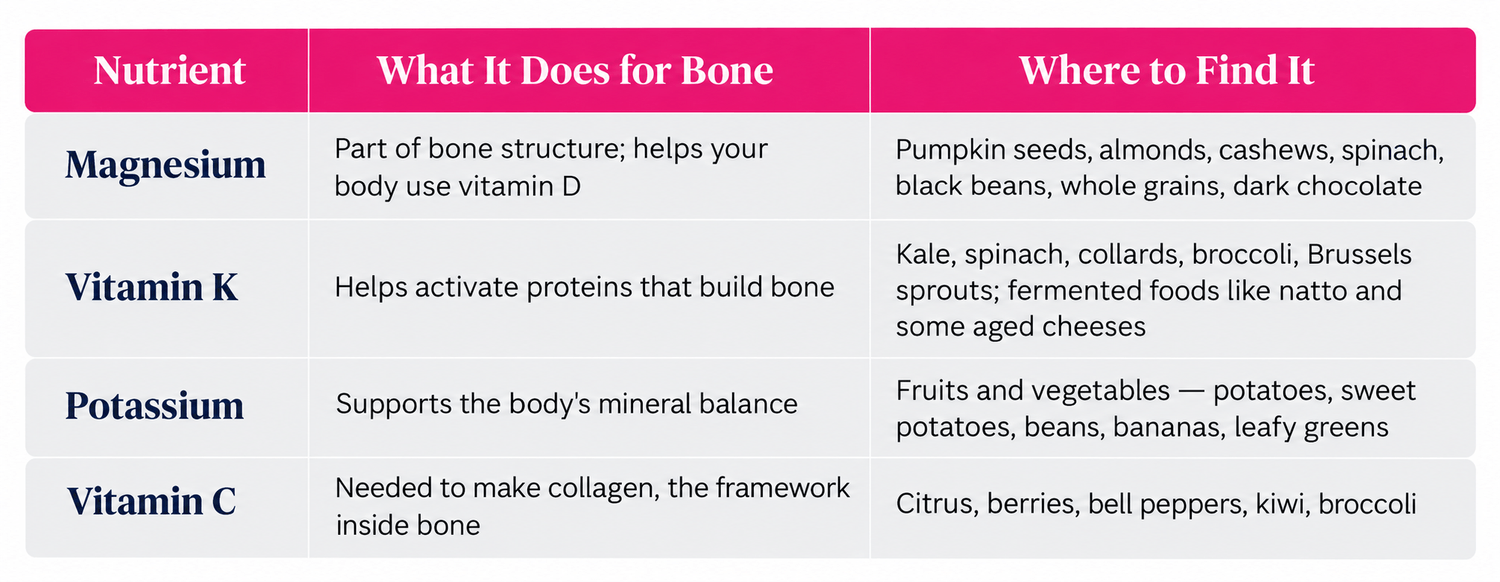
A colorful plate built around vegetables, fruits, beans, nuts, seeds, and whole grains covers most of these naturally.
Add prunes to your day. Prunes (dried plums) are one of the most studied foods for bone health in post-menopausal women. In a year-long Penn State study of 235 post-menopausal women, those who ate 50 grams of prunes a day (about 5–6 prunes) maintained their hip bone density, while the group that ate no prunes lost significant bone at the hip. [10] Researchers believe prunes may help by reducing inflammation and oxidative stress, which both contribute to bone loss. [11]
Enjoy them as a snack, chopped into oatmeal or yogurt, or blended into a smoothie. Prunes are rich in fiber, so if you're new to them, start with a few a day and work up.
Step 8: Limit What Works Against Your Bones
Protecting your bones is also about easing off the things that quietly wear them down.
Alcohol. Drinking can speed up bone loss. [12] If you drink, keep it moderate, and consider saving it for special occasions.
Smoking. Smoking speeds up bone loss, too. [12] Quitting at any age helps your bones, heart, and lungs.
Under-eating. A low body weight is a known risk factor for weaker bones. [13] Very restrictive diets can also leave your bones short on the calcium, protein, and calories they need. Nourishing your body is part of protecting it.
Sitting for long stretches. Bones need movement to stay strong. Get up and move every hour or so — a few heel drops while the coffee brews counts.
A Note on Supplements: Food First
It's tempting to reach for a bottle, but whole foods are the best foundation for your bones. Supplements work best as a way to fill a true gap, not as a replacement for a nourishing plate.
Calcium. Too much calcium from supplements has been linked to kidney stones. [7] If you use one, add up what you already get from food first, and only fill the difference.
Vitamin D. Supplements can help when sunlight and food fall short, especially in winter. More isn't better — there is an upper limit. [7]
Magnesium and vitamin K. Both matter for bone, but research on taking them as supplements is still limited or mixed. [9][14] Leafy greens, nuts, seeds, beans, and whole grains are a reliable way to get them.
Choose quality. If you do supplement, look for third-party tested brands, and add one thing at a time so you can tell what's helping.
Vitamin K can interact with blood thinners, and calcium and magnesium can affect how some medications are absorbed. If you take any medications, check for interactions before adding a supplement.
Part Three: Make It Yours
Step 9: Track Your Bone Habits
Bone changes happen slowly and silently, so you won't feel progress the way you feel stronger muscles. Tracking your habits is how you know you're giving your bones what they need, week after week.
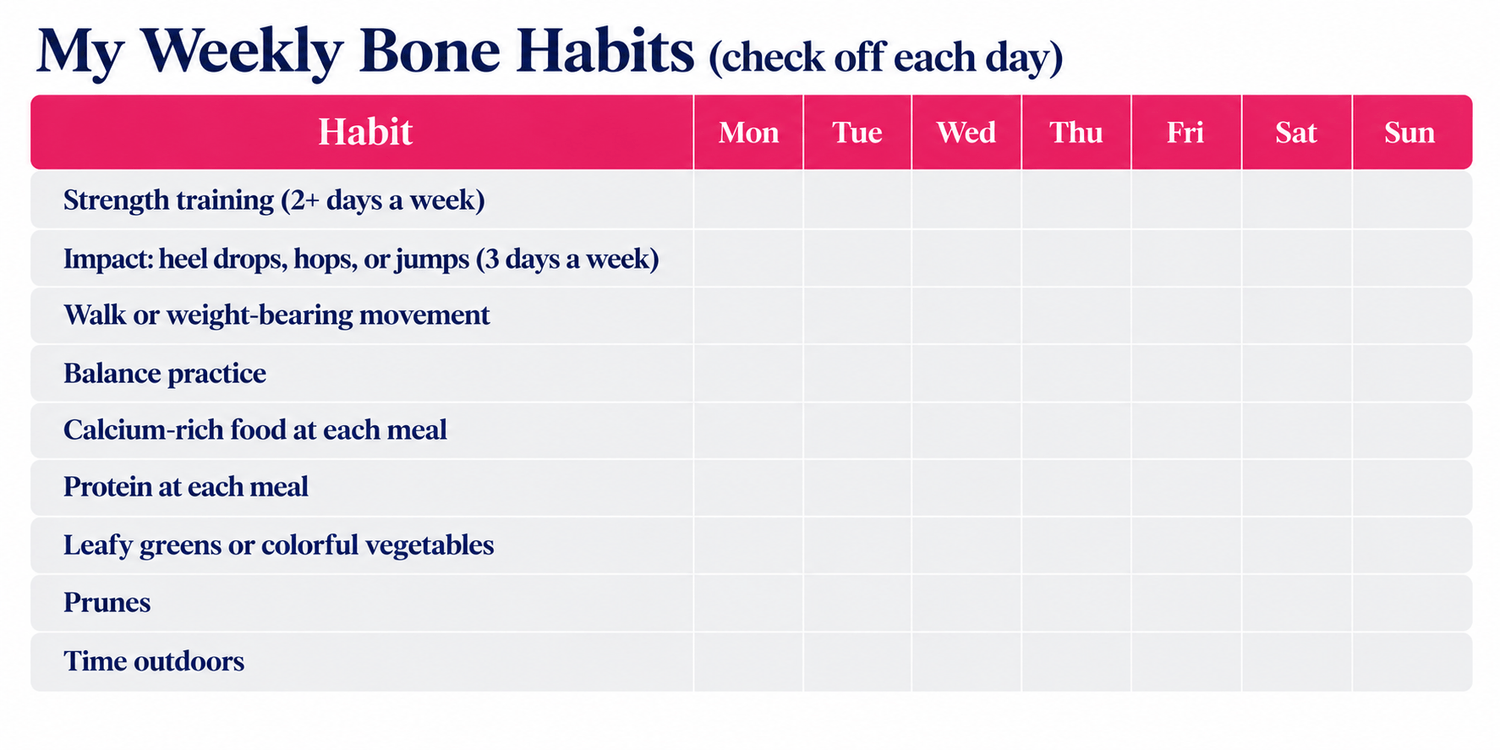
My Notes This Week: What felt easy? What do I want to focus on next week?
Listen to Your Body
Pay attention to how your body responds. Building stronger bones takes consistency, but exercise should never cause sharp pain or leave you feeling worse.
Adjust if you notice:
Joint pain during or after impact moves — stop the painful movement and consider a lower-impact alternative, such as walking or another activity appropriate for your bone health and physical abilities.
Leaking or pressure in your pelvis when you jump — pause jumping and focus on pelvic floor-friendly movements. A pelvic floor physical therapist can help you build strength and determine when higher-impact exercise may be appropriate.
Sharp or lasting back pain — stop the activity and seek medical guidance, particularly if you have osteoporosis or a history of fractures. Avoid pushing through pain or attempting heavy lifting until you understand what's causing it.
Get checked promptly if you experience significant pain after a fall or minor bump, sudden unexplained back pain, or notice you're losing height. These can sometimes indicate a vertebral or other fragility fracture.
If you have osteoporosis or a history of fractures, you can still benefit from appropriate strength training and weight-bearing movement. The key is choosing exercises that match your individual needs and fracture risk. A healthcare provider or physical therapist familiar with osteoporosis can help you create a safe, effective plan.
Your Bone Plan at a Glance
Stimulus
Strength train at least twice a week, focusing on hips, legs, spine, and upper back.
Add appropriate weight-bearing movement and, when safe for your bone health, gradually incorporate impact exercises.
Walk and move daily, practice balance, and fall-proof your home.
Nutrition
Aim for 1,200 mg of calcium a day, mostly from food, spread across meals.
Get vitamin D from sunshine, fatty fish, eggs, and fortified foods.
Eat protein at every meal, paired with calcium.
Fill your plate with leafy greens, colorful vegetables, fruits, nuts, seeds, and beans — and consider 5–6 prunes a day.
Limit alcohol, avoid smoking, and nourish your body fully.
Ownership
Track your habits weekly and adjust as you go.
A question to sit with:
If my bones could speak, what would they ask me for this week — and which one step can I give them?
Educational Disclaimer
This article is for educational and informational purposes only. It is not intended to diagnose, treat, cure, or prevent any disease or medical condition, and it is not a substitute for professional medical advice. You know your body best — listen to it, move within your own abilities, and adjust as needed. If you have a health condition, injury, known osteoporosis, or take medications, seek guidance from a qualified professional before starting a new exercise routine, supplement, or dietary change. If you have a fall or sudden pain that concerns you, seek medical care.
Sources
Michigan State University Extension. Osteoporosis: How does bone loss happen? Part 1.
Vanderbilt Health. Women: What You Need to Know About Bone Loss.
Cedars-Sinai. Exercise and Older Adults.
Watson SL, et al. High-Intensity Resistance and Impact Training Improves Bone Mineral Density and Physical Function in Postmenopausal Women With Osteopenia and Osteoporosis: The LIFTMOR Randomized Controlled Trial. Journal of Bone and Mineral Research, 2018.
Manchester Metropolitan University. Six minutes of exercise a week could prevent post-menopause osteoporosis. February 2019.
The Scotsman. Six minutes of exercise a week cuts women's risk of bone thinning (summary of Montgomery G, et al., Journal of Electromyography and Kinesiology, 2019).
Institute of Medicine (National Academies). IOM Report Sets New Dietary Intake Levels for Calcium and Vitamin D. 2010.
Rizzoli R, et al. Benefits and safety of dietary protein for bone health — an expert consensus paper endorsed by ESCEO and the International Osteoporosis Foundation. Osteoporosis International, 2018.
da Silva TDB, et al. Supplements for bone health. Archives of Endocrinology and Metabolism, 2025.
Sci.News. Daily Prune Consumption Improves Bone Health, New Study Finds (Penn State research).
Penn State University. Eating prunes may help protect against bone loss in older women.
Stony Brook Medicine. Menopause and Bone Health: Understanding Your Risk for Osteoporosis After 50.
Links Medicus. Screening for Osteoporosis to Prevent Fractures: Updated USPSTF Guidelines.
Vitamin K and bone health in older adults. Journal of Nutrition in Gerontology and Geriatrics, 2014.

LOOKING FOR MORE PERSONALIZED SUPPORT?
You Don't Have to Figure It All Out Alone
If you've been trying to make sense of changing symptoms, energy, hormones, nutrition, or other wellness concerns, a conversation can help you organize what you're noticing and identify where you may want to focus next.
Start with a complimentary 20-minute connection call.
Let's see whether working together feels like the right fit.

Nat's Wellness Journey is a space for approachable wellness education, practical resources, and real-life learning to help women better understand their bodies and make informed choices about their health.
💌 natalie@natswellnessjourney.com
Credential & Certifications





© 2026 Nat's Wellness Journey. All Rights Reserved
Privacy Policy | Terms of Use | Disclosure | Health Disclaimer