Post-Menopause: Your Heart and Metabolic Health Deserve a Front-Row Seat
PLEASE NOTE: My goal is to help you better understand your body through education. The information shared in these Q&A articles is for informational purposes only and should not replace advice from your physician or other qualified healthcare provider. As research continues to grow, recommendations and scientific understanding may change over time. I encourage you to do your own research, ask questions, and work with a healthcare professional to determine what's best for your unique situation.
Pay attention to your blood pressure, blood sugar, cholesterol, and overall metabolic health.
When women think about menopause, they usually think about hot flashes, sleep, and mood. Heart health often isn't on the list.
But the years around and after menopause are when heart and metabolic health need your attention most. The changes are often quiet — you can't feel your cholesterol rising or your blood pressure creeping up. Knowing what to watch for, and taking simple steps now, can make a real difference for the decades ahead.
What Changes After Menopause
Before menopause, estrogen may help protect the heart. As estrogen production drops, that protection fades. [1]
In 2020, the American Heart Association (AHA) released its first scientific statement focused on menopause and heart health. It found that the menopause transition is a time of accelerated heart disease risk for women. [2] Changes in hormones, body composition, cholesterol, and blood vessel health during this time can raise the risk of heart disease after periods stop. [1]
Some of the most common changes include:
Cholesterol: LDL ("bad") cholesterol tends to rise during midlife, and this appears to be driven by menopause more than by aging itself. [3]
Body fat: Fat tends to shift toward the middle and around the organs, including around the heart. [3][4]
Metabolic health: The risk of metabolic syndrome — a cluster that includes higher blood sugar, blood pressure, and belly fat — goes up. [3]
Blood pressure and blood sugar: These also tend to rise, though researchers believe aging plays a bigger role here than menopause itself. [5]
Women who reach menopause earlier also tend to have higher heart disease risk. [3]
Why This Matters
Heart disease is the leading cause of death in women, and risk rises noticeably after menopause. Women tend to develop heart disease several years later than men, often after this transition. [6]
Many of the early warning signs — higher cholesterol, rising blood pressure, creeping blood sugar — have no symptoms at all. The only way to know is to check.
The AHA has also noted that some common menopause symptoms, like hot flashes, night sweats, depression, and sleep problems, have been linked with heart disease. [1] That's one more reason to bring those symptoms up with your provider, rather than just pushing through.
Research suggests that healthy lifestyle changes during this stage can help prevent weight gain and lower blood pressure, blood sugar, insulin, and triglycerides. [5] What you do now counts.
Know Your Numbers
These are the key numbers to know, along with the healthy targets the AHA uses. [4][7][8][9]
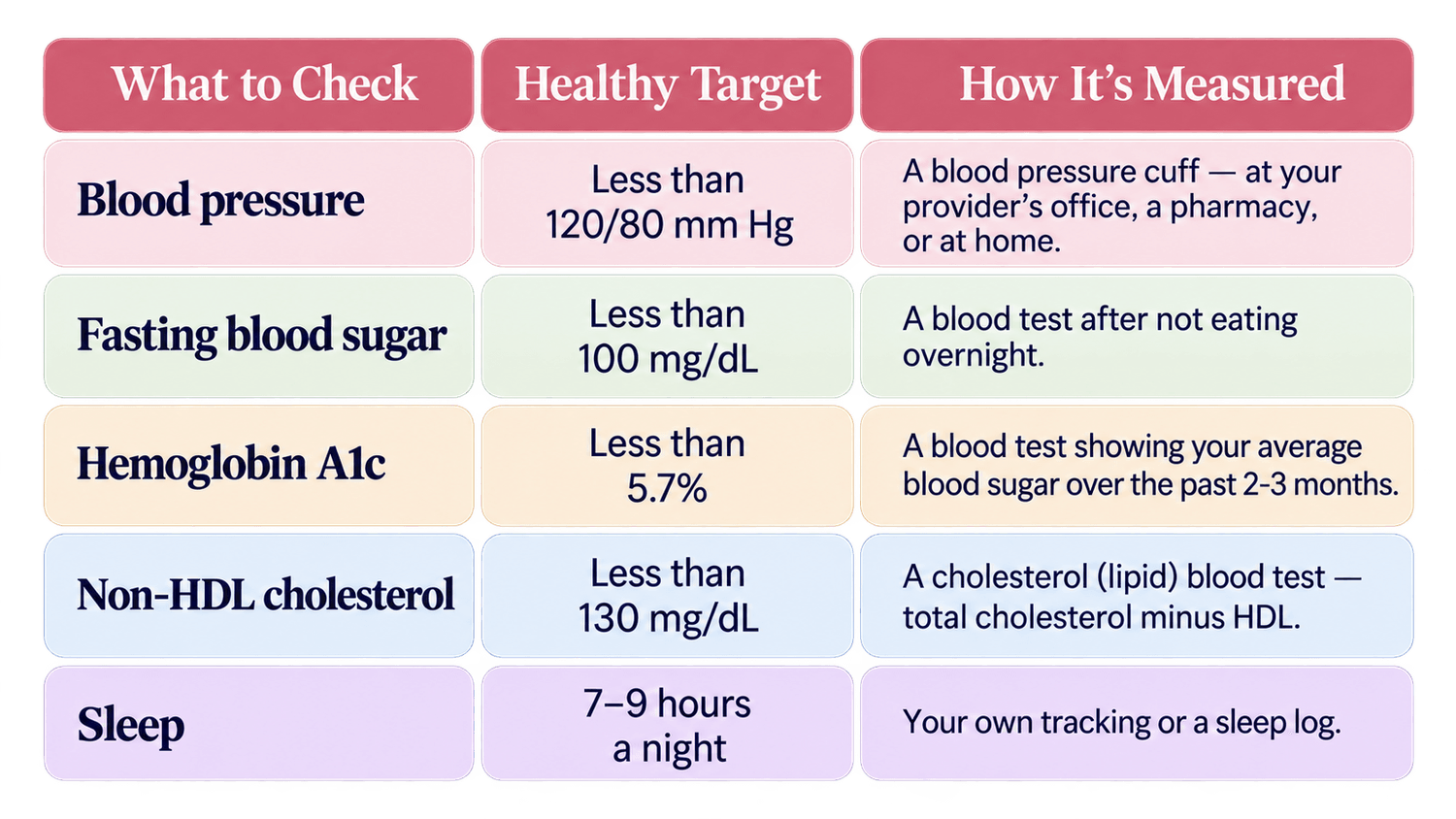
If your numbers are outside these ranges, you're not alone, and it doesn't mean something bad will happen. It means you have useful information to act on with your provider.
If you've followed the perimenopause content on this site, you may remember that standard labs can miss early changes in how your body handles blood sugar. It's okay to ask your provider whether a fasting insulin test makes sense for you.
What You Can Do
The AHA's Life's Essential 8 outlines the eight things that most shape heart health: diet, physical activity, nicotine avoidance, sleep, healthy weight, and healthy cholesterol, blood sugar, and blood pressure. [7] You don't need to work on all eight at once. Small improvements in a few areas still count. [9]
Eat with your heart in mind. Build meals around vegetables, fruits, whole grains, beans, nuts, fish, and olive oil. Choose lower-sodium seasonings and lower-sugar drinks. [9]
Steady your blood sugar. Include protein and fiber at meals, and pair carbohydrates with protein, fat, or fiber rather than eating them alone. A short walk after meals can help too.
Move most days. Aim for about 150 minutes a week of moderate activity, like brisk walking, plus strength training (see the article on muscle in this series). [9]
Protect your sleep. The AHA added sleep to its heart health checklist in 2022, with 7–9 hours a night as the goal for adults. [8][10]
Avoid nicotine and secondhand smoke. Quitting improves blood pressure and lowers the risk of blood clots and heart attack. [11]
Manage stress. Stress isn't on the official list, but it affects blood pressure, blood sugar, and sleep, so calming practices like slow breathing, prayer, time outdoors, or connection with others are worth making room for.
Check your numbers regularly and keep a simple record, so you can see changes over time.
When to Talk With a Provider
Ask your provider to check your heart and metabolic numbers at least once a year, or more often if:
Any of your numbers are outside the healthy targets above
You went through menopause early [3]
Heart disease, stroke, or diabetes runs in your family
You have frequent hot flashes, night sweats, low mood, or poor sleep [1]
You're noticing weight gain around your middle, constant hunger, or energy crashes after meals
A simple way to start the conversation: "I'm post-menopausal and want to stay ahead of my heart health. Can we review my blood pressure, blood sugar, and cholesterol, and talk about my overall risk?"
Get emergency help right away — call 911 — if you have chest pain or pressure, shortness of breath, pain in your jaw, neck, back, or arm, sudden nausea or cold sweats, or sudden weakness, confusion, or trouble speaking. Women's heart attack symptoms can be subtler than the classic picture, so trust what your body is telling you.
The Takeaway
Heart disease is the leading cause of death in women, and risk rises after menopause.
Cholesterol, body fat distribution, and metabolic health can shift during this time — often without symptoms.
Knowing your blood pressure, blood sugar, and cholesterol numbers is the first step.
Eating well, moving daily, sleeping 7–9 hours, avoiding nicotine, and managing stress all protect your heart.
Small, steady changes in a few areas make a real difference.
A question to sit with: Do I know my numbers — and if not, when will I find out?
Educational Disclaimer
This article is for educational and informational purposes only. It is not intended to diagnose, treat, cure, or prevent any disease or medical condition, and it is not a substitute for professional medical advice. Always speak with a qualified healthcare provider about your individual needs, before starting a new exercise routine, supplement, or dietary change, and especially if you are taking medication or managing another health condition. If you have symptoms of a heart attack or stroke, call 911 right away.
Sources
HealthDay News, via OrthoAtlanta. Years Leading to Menopause See Uptick in Women's Heart Risks: AHA. November 2020.
Contemporary OB/GYN. 2020 AHA Statement on Menopause and Cardiovascular Risk.
American Heart Association. Top Things to Know: Menopause Transition and Cardiovascular Disease Risk. 2020.
Cleveland Clinic Journal of Medicine. Clinical Impact of 2020 American Heart Association Statement on Menopause and Cardiovascular Disease Risk. 2022.
MDedge. New AHA Scientific Statement on Menopause and CVD Risk.
El Khoudary SR, et al. Menopause Transition and Cardiovascular Disease Risk: Implications for Timing of Early Prevention. Circulation, 2020.
Lloyd-Jones DM, et al. Life's Essential 8: Updating and Enhancing the American Heart Association's Construct of Cardiovascular Health. Circulation, 2022.
UofL Health. Life's Essential 8: Unlock the Secrets to Heart Health.
Midtown Nutrition. Life's Essential 8 (summary of the AHA guidelines).
ScienceDaily. American Heart Association adds sleep to cardiovascular health checklist. June 2022.
Brown University Health. Life's Essential 8: Improve Your Heart Health and More.

LOOKING FOR MORE PERSONALIZED SUPPORT?
You Don't Have to Figure It All Out Alone
If you've been trying to make sense of changing symptoms, energy, hormones, nutrition, or other wellness concerns, a conversation can help you organize what you're noticing and identify where you may want to focus next.
Start with a complimentary 20-minute connection call.
Let's see whether working together feels like the right fit.

Nat's Wellness Journey is a space for approachable wellness education, practical resources, and real-life learning to help women better understand their bodies and make informed choices about their health.
💌 natalie@natswellnessjourney.com
Credential & Certifications






© 2026 Nat's Wellness Journey. All Rights Reserved
Privacy Policy | Terms of Use | Disclosure | Health Disclaimer