Protect Your Strength: How to Build and Preserve Muscle After Menopause
PLEASE NOTE: My goal is to help you better understand your body through education. The information shared in these Q&A articles is for informational purposes only and should not replace advice from your physician or other qualified healthcare provider. As research continues to grow, recommendations and scientific understanding may change over time. I encourage you to do your own research, ask questions, and work with a healthcare professional to determine what's best for your unique situation.
Build and preserve muscle so your body stays capable.
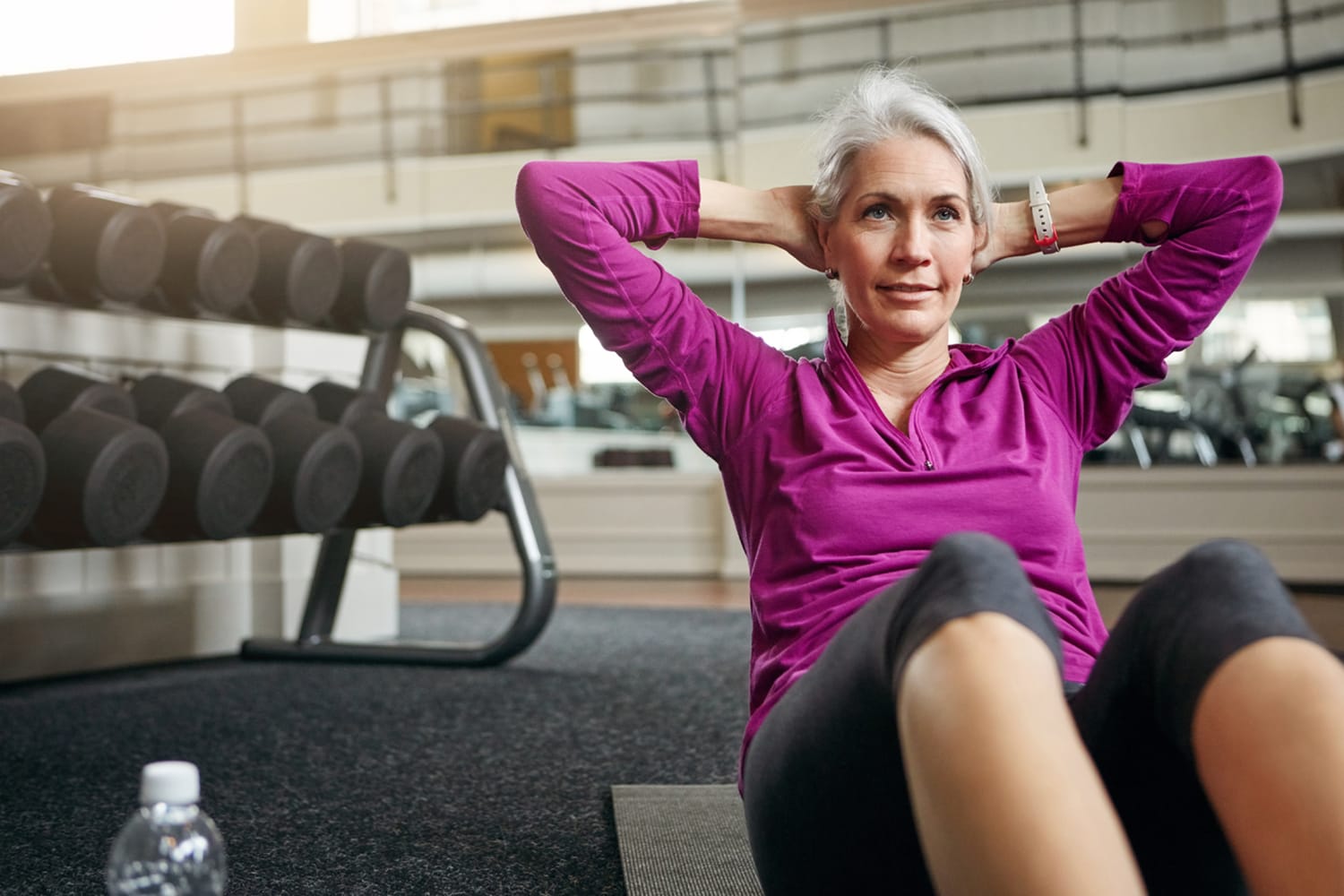
Menopause isn't only about what can go wrong. It's about protecting your ability to live your life — to carry the groceries, lift the grandbaby, climb the trail, and get up off the floor with ease.
Your strength is yours to build and yours to keep. This guide walks you through it step by step, using what you already have, at a pace that works with your body. You don't need a gym, a trainer, or a perfect plan. You need a starting point, a few simple movements, and the consistency to keep showing up for yourself.
Why Your Strength Is Worth Protecting
Muscle naturally declines with age, and the drop in estrogen around menopause can speed that up. A study that followed women from perimenopause into post-menopause found measurable muscle loss over the transition — and also found that women who stayed physically active held on to more of their muscle. [1]
Your body still responds to strength work after menopause. In one study, post-menopausal women who strength trained twice a week for eight months improved their bone density, strength, and everyday physical function. [2]
In other words, what you do with your body still matters — and it's never too late to start.
Step 1: Know Your Starting Point
Before you start, take a quick snapshot of where you are today. This isn't a test you pass or fail — it's simply your baseline, so you can see your progress later.
Try these three simple checks, and write down your results:
Chair stand: Sit in a sturdy chair with your arms crossed over your chest. Count how many times you can stand up fully and sit back down in 30 seconds.
Wall push-up: Stand an arm's length from a wall. Count how many push-ups you can do with good form before you need to stop.
Balance: Standing near a counter for support, lift one foot slightly off the floor. Time how long you can hold it (up to 30 seconds). Then switch sides.
Also notice how everyday tasks feel. Is it easy to carry groceries, climb stairs, or get up from the floor? Those real-life moments are what this is all about.
Repeat these checks every 4–6 weeks to see how far you've come.
Step 2: Gather Your Strength Tools
You can build real strength with what's already in your home. Start with what you have and add tools as you grow.
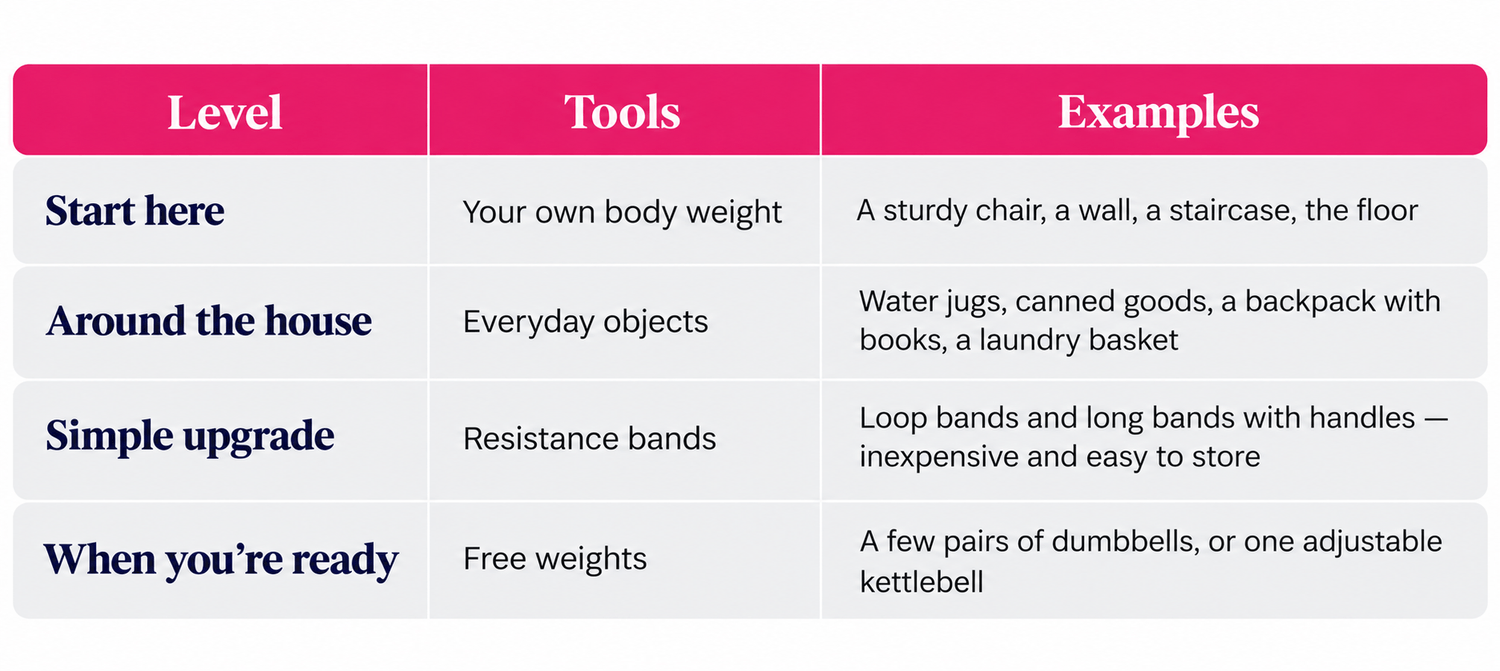
There's no wrong place to start. A woman doing chair stands in her kitchen is building strength just as truly as someone at a gym.
Step 3: Learn the Foundational Movements
You can build real strength with what's already in your home. Start with what you have and add tools as you grow.
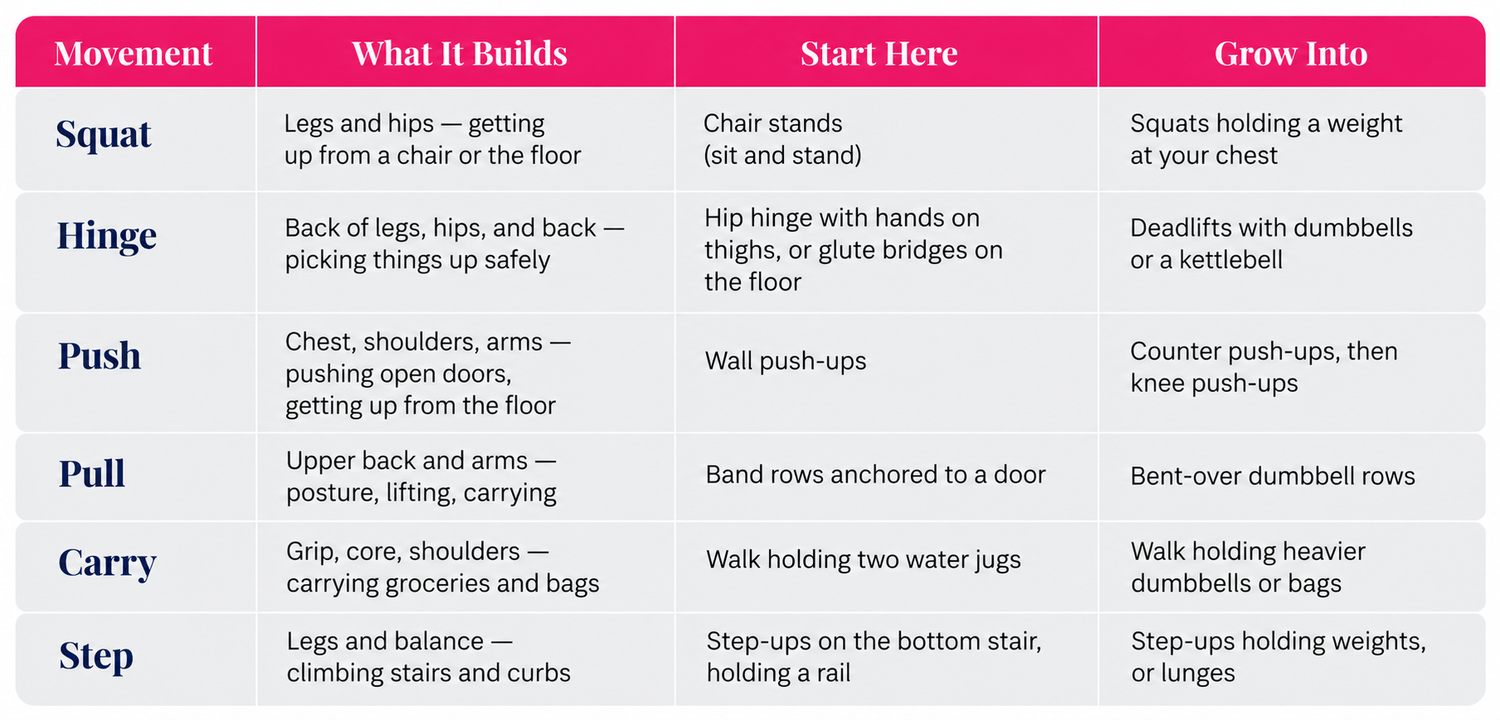
Add a little balance work most days, too — standing on one foot near a counter, or walking heel to toe down a hallway.
Focus on form first. Move slowly and with control, breathe out as you push or lift, and stay in a range that feels comfortable for your joints.
Step 4: Build Your Weekly Rhythm
Aim for strength work on at least two days a week, with a rest day in between. [3] Pair it with regular walking — the CDC suggests about 150 minutes a week of moderate activity, like brisk walking. [3]
Each strength session can be as short as 20–30 minutes. Do each of the six movements for 1–2 rounds of 8–12 repetitions, resting as long as you need between them.
Here's one simple way a week could look:
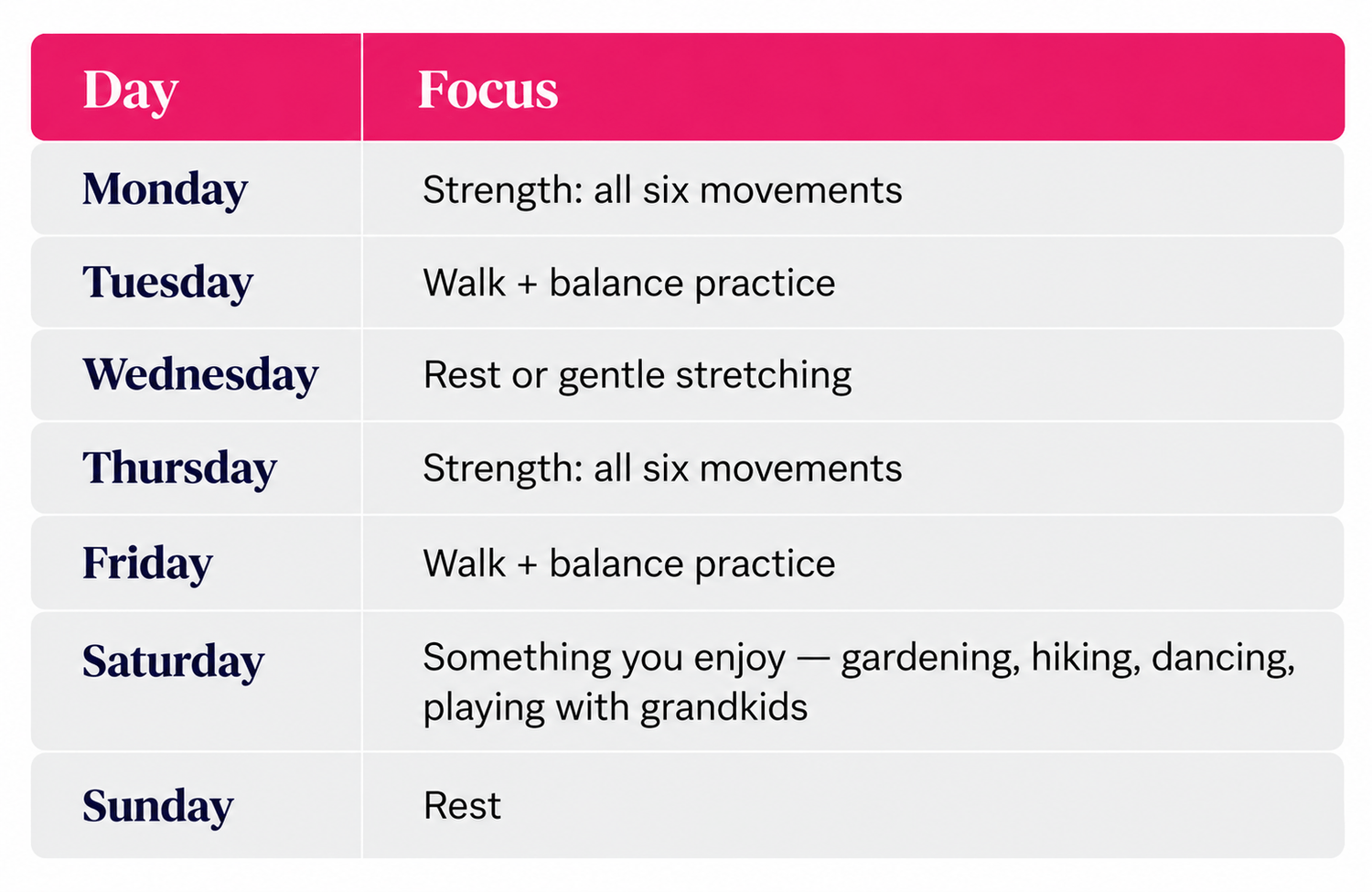
Make this your own. If two days is all you can manage right now, two days is a wonderful start. Consistency over months matters far more than any single workout.
Step 5: Progress Gradually
Muscle grows when it's asked to do a little more than it's used to. The key is to challenge your body without overwhelming it.
Find the right effort. The last two or three repetitions of each round should feel challenging, but you should still be able to keep good form. If you could easily do ten more, it's time to make it a little harder.
Make it harder one way at a time. When a movement starts to feel easy, choose just one of these:
Add a few more repetitions (work up to 12–15)
Add another round
Add a little more weight or a stronger band
Move to the next version of the movement (for example, from wall push-ups to counter push-ups)
Slow it down — take three seconds to lower each time
Give it time. Many women notice everyday tasks feeling easier within a few weeks. Visible changes in muscle often take longer. Keep going — the strength is building even before you can see it.
Step 6: Fuel Your Muscles
Strength work gives your muscles the signal to grow. Protein gives them the building blocks.
As we age, our bodies don't use protein as efficiently as they once did, so older adults need more protein than younger adults to maintain muscle — and even more when they're active. [4]
Simple ways to put this into practice:
Include protein at every meal, not just dinner. A palm-sized portion or more is an easy visual guide.
Start your day with protein. Eggs, Greek yogurt, cottage cheese, or a protein smoothie are quick options.
Keep easy protein on hand: rotisserie chicken, canned tuna or salmon, beans and lentils, tofu, cheese, nuts, and seeds.
Add protein to snacks: a hard-boiled egg, a cheese stick, hummus with veggies, or a handful of almonds.
Have a protein-rich meal or snack after strength sessions to support recovery.
If you have kidney concerns or follow a special diet, your protein needs may be different.
Step 7: Recover Well
Muscles grow stronger while you rest, not just while you work. Recovery is part of the plan, not a reward for finishing it.
Rest between strength days. Give each muscle group at least a day off before working it hard again.
Protect your sleep. Deep sleep is when your body does much of its repair work. A cool, dark room and a steady wake time help.
Keep moving gently on rest days. Walking, stretching, or light yoga keeps you limber without adding strain.
Notice soreness. Mild soreness for a day or two after a new challenge is normal. If you're very sore, ease back a little next time.
Stay hydrated and eat regular, nourishing meals so your body has what it needs to rebuild.
Step 8: Track Your Strength
Writing it down helps you see progress that's easy to miss day to day — and it's motivating to look back and see how far you've come.
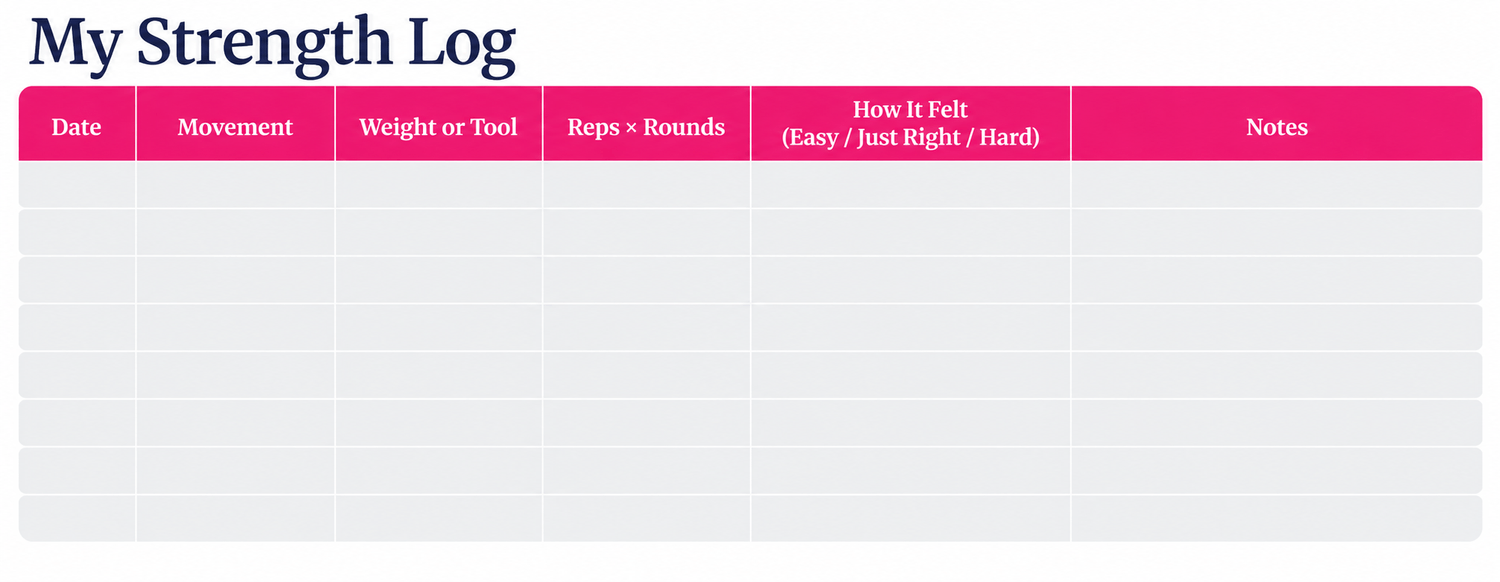
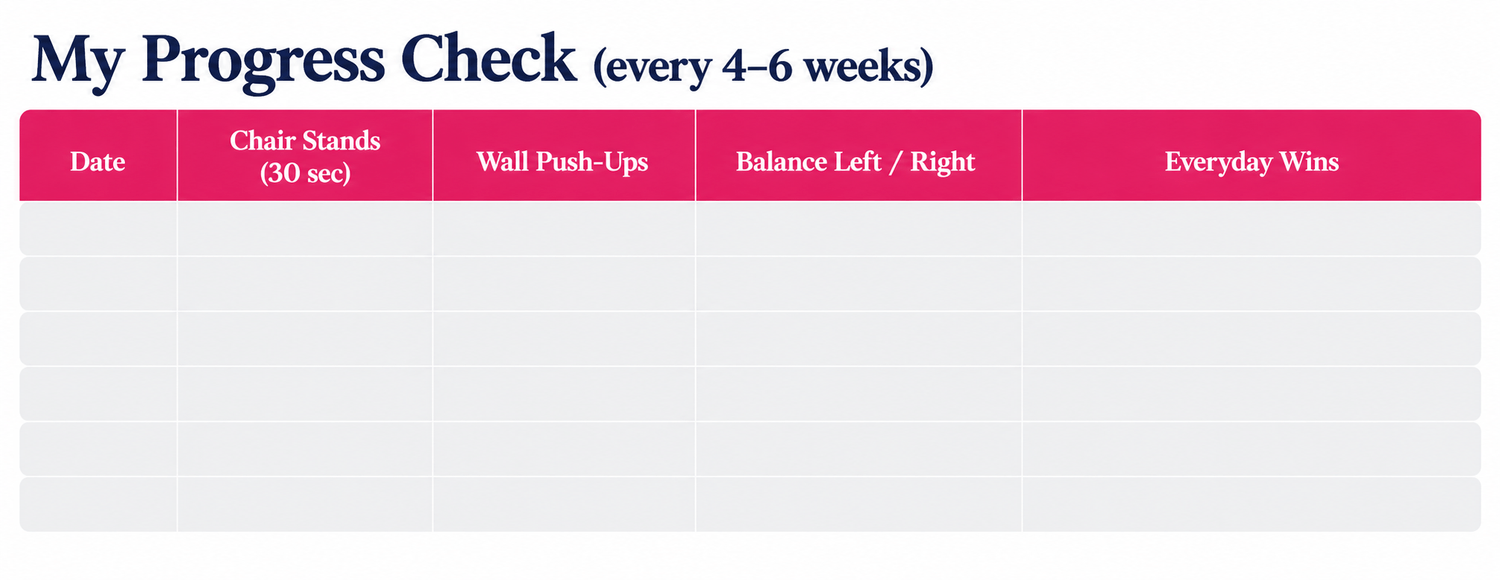
The "Everyday Wins" column might be your favorite. Carrying all the groceries in one trip, getting up off the floor without help, keeping up on a hike — those are the moments that show your strength is working for your life.
Listen to Your Body
You know your body better than anyone. Building strength should feel challenging, but never harmful.
Ease back or adjust if you notice:
Sharp or pinching pain in a joint (as opposed to the normal burn of working muscles)
Soreness that lasts more than a few days
Feeling drained rather than energized for most of the day after a session
Pain that changes how you move or walk
Try a smaller range of motion, a lighter weight, or an easier version of the movement. There's always a way to keep moving that works for your body.
Stop right away and seek care if you feel chest pain or pressure, dizziness, unusual shortness of breath, or a racing or irregular heartbeat during activity.
If you have a known heart condition, osteoporosis, a recent injury or surgery, or ongoing joint pain, get personalized guidance before starting a new strength routine — then use this guide alongside it.
Your Strength Plan at a Glance
Know your starting point — chair stands, wall push-ups, balance.
Use what you have — body weight, household items, bands, then weights.
Practice six movements — squat, hinge, push, pull, carry, step — plus balance.
Strength train at least twice a week, and walk regularly.
Progress gradually — one small step harder at a time.
Include protein at every meal.
Recover well — rest days, sleep, gentle movement.
Track your progress and celebrate everyday wins.
A question to sit with: What do I want my strength to let me keep doing — and what's one step I can take toward it this week?
Educational Disclaimer
This article is for educational and informational purposes only. It is not intended to diagnose, treat, cure, or prevent any disease or medical condition, and it is not a substitute for professional medical advice. You know your body best — listen to it, move within your own abilities, and adjust as needed. If you have a health condition, injury, or concern, seek guidance from a qualified professional before starting a new exercise routine or making dietary changes. If you experience chest pain, dizziness, or other concerning symptoms, stop and seek medical care right away.
Sources
Juppi HK, et al. Role of Menopausal Transition and Physical Activity in Loss of Lean and Muscle Mass: A Follow-Up Study in Middle-Aged Finnish Women. Journal of Clinical Medicine, 2020.
Watson SL, et al. High-Intensity Resistance and Impact Training Improves Bone Mineral Density and Physical Function in Postmenopausal Women With Osteopenia and Osteoporosis: The LIFTMOR Randomized Controlled Trial. Journal of Bone and Mineral Research, 2018.
Centers for Disease Control and Prevention. How Much Physical Activity Do Older Adults Need? (archived).
Bauer J, et al. Evidence-Based Recommendations for Optimal Dietary Protein Intake in Older People: A Position Paper From the PROT-AGE Study Group. Journal of the American Medical Directors Association, 2013.

LOOKING FOR MORE PERSONALIZED SUPPORT?
You Don't Have to Figure It All Out Alone
If you've been trying to make sense of changing symptoms, energy, hormones, nutrition, or other wellness concerns, a conversation can help you organize what you're noticing and identify where you may want to focus next.
Start with a complimentary 20-minute connection call.
Let's see whether working together feels like the right fit.

Nat's Wellness Journey is a space for approachable wellness education, practical resources, and real-life learning to help women better understand their bodies and make informed choices about their health.
💌 natalie@natswellnessjourney.com
Credential & Certifications





© 2026 Nat's Wellness Journey. All Rights Reserved
Privacy Policy | Terms of Use | Disclosure | Health Disclaimer