What Is Perimenopause?

PLEASE NOTE: My goal is to help you better understand your body through education. The information shared in these Q&A articles is for informational purposes only and should not replace advice from your physician or other qualified healthcare provider. As research continues to grow, recommendations and scientific understanding may change over time. I encourage you to do your own research, ask questions, and work with a healthcare professional to determine what's best for your unique situation.

You woke up one morning and something felt different. Not one big thing — just a handful of small ones, stacking up quietly over weeks or months. The workouts that used to work don't seem to anymore. The weight that used to come off with a little effort just... doesn't. The energy you used to count on to get through your afternoon isn't there the way it used to be. Your patience feels shorter. Your sleep feels lighter. None of it is dramatic enough to point to and say "this is a problem" — it's more like you don't quite feel like yourself, and you can't explain why.
Hormones can begin fluctuating years before your period actually stops. You may notice changes in sleep, energy, mood, body composition, cycles, cravings, temperature regulation, or how you respond to stress. If any of that sounds familiar, you're likely in perimenopause — a stage most women go through with far less information than they deserve. This is meant to be the deep, real explanation nobody handed you. We'll go into specific topics — HRT, sleep, symptom-by-symptom management — in more depth in future articles. For now, let's cover the whole picture.
What the heck is Perimenopause?
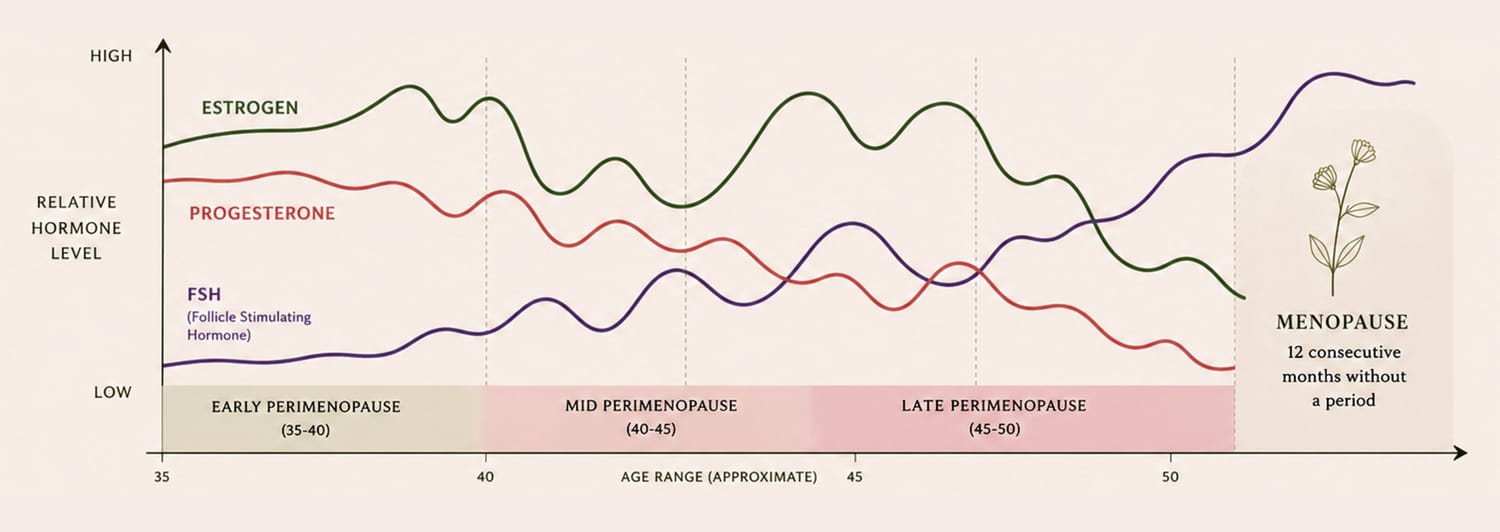
Perimenopause is the transition leading up to menopause — the years when your ovaries gradually produce less and less predictable hormone output, causing your cycle and your body to shift in response.¹ It's easy to confuse the terms, so here's the clean distinction: menopause is a single point in time, officially marked once you've gone 12 full months without a period. Perimenopause is everything leading up to that point — sometimes years of it.
When it starts, and how long it lasts
For most women, perimenopause begins between ages 45 and 47, though the full normal range stretches from the early 40s all the way to the mid-30s on the early end and mid-50s on the later end.² On average, this transition lasts about four years before periods stop completely — but it can run as long as eight.² It's typically described in two stages: early perimenopause, where cycle length starts varying by a week or more, and late perimenopause, where you go 60 days or longer without a period, right up until your final one.²

What's Actually Going on With Your Hormones
Meet the Three Main Hormones: Progesterone, Estrogen and FSH
Progesterone
The first hormone to decline — often years before estrogen even starts shifting.³ That's because progesterone production depends entirely on ovulation, and ovulation becomes inconsistent early in this transition. No reliable ovulation, no reliable progesterone.
Estrogen
The more surprising one. Most people assume it just gradually fades, but that's not accurate — estradiol doesn't decline smoothly. It swings, sometimes spiking higher than your typical reproductive-year levels, before eventually trending down as you approach menopause.³ This is a major reason perimenopause can feel so unpredictable: your hormones aren't calmly stepping down, they're fluctuating like a rollercoaster.
FSH (follicle-stimulating hormone) is part of why.
As your ovaries respond less predictably to FSH, your body sends out more of it trying to trigger ovulation — meaning FSH levels can be high one day and low the next.³ This single fact explains why a single hormone blood test often can't reliably tell you where you are in this process (more on that below).
The Full Symptom Picture
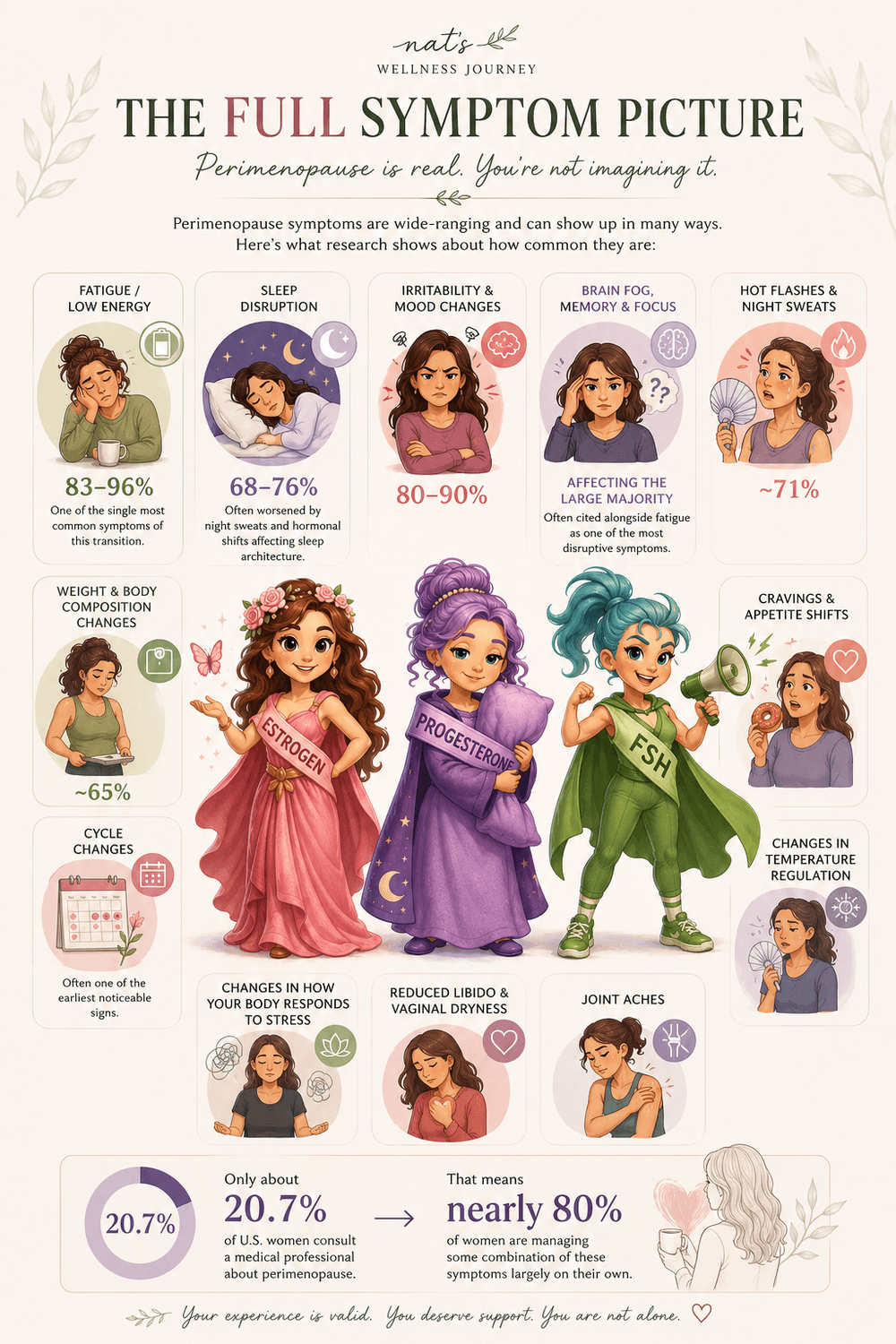
Perimenopause symptoms are genuinely wide-ranging, and the research on how common they are is worth knowing, because it reframes a lot of what women blame on stress, aging, or "just not managing life well":⁴
Fatigue / low energy — reported by 83–96% of women, making it one of the single most common symptoms of this transition
Sleep disruption — 68–76%, often worsened by night sweats and hormonal shifts affecting sleep architecture directly
Irritability and mood changes — 80–90%
Brain fog, memory issues, difficulty concentrating — affecting the large majority of women, frequently cited alongside fatigue as one of the most disruptive symptoms
Hot flashes and night sweats — around 71%
Weight and body composition changes — around 65%
Cycle changes — irregular timing, flow, or length, often one of the earliest noticeable signs
Cravings and appetite shifts
Changes in temperature regulation
Changes in how your body responds to stress
Reduced libido and vaginal dryness
Joint aches
Here's a statistic worth sitting with: only about 20.7% of U.S. women consult a medical professional about perimenopause.⁴ That means nearly 80% of women are managing some combination of the symptoms above largely on their own, often without even realizing there's a name for what they're experiencing.
Why Your Body Composition Changes Specifically
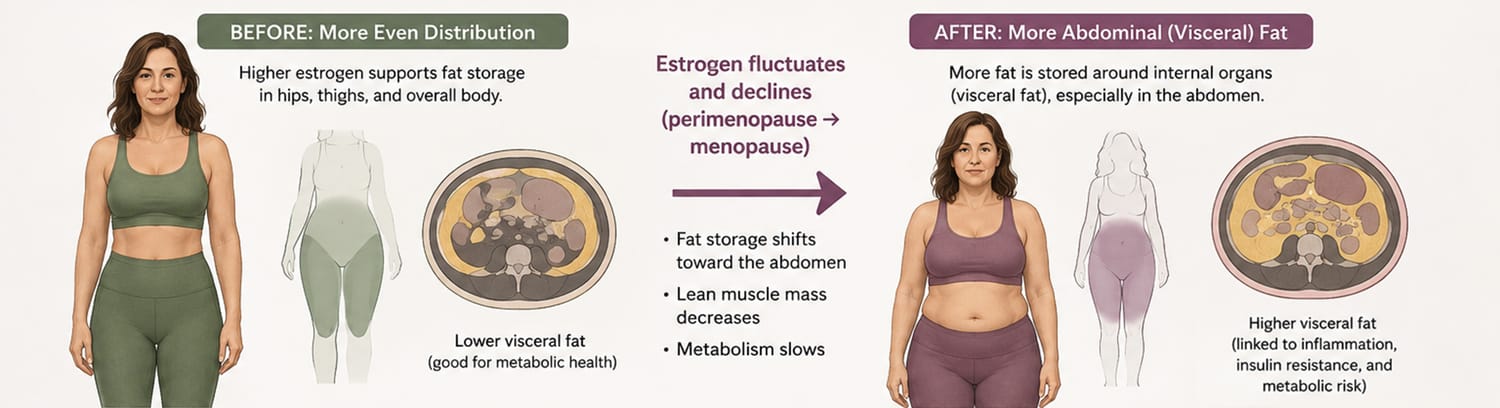
This deserves its own explanation, since it connects directly to what we've covered elsewhere in this library. As estrogen fluctuates and eventually declines, fat storage tends to shift from a more evenly distributed pattern toward the abdomen — an increase in visceral fat specifically, the same metabolically active fat tissue we discussed in the inflammation deep dive.⁵ At the same time, lean muscle mass tends to decrease, which slows metabolism and can accelerate fat gain further if nothing adjusts to compensate.⁵ This is also exactly why the protein target discussed in the macro-counting article gets more important during this stage — your body needs more support to hold onto muscle than it did a decade earlier, not because you're doing anything wrong, but because the hormonal environment genuinely changed.
How is it actually diagnosed?
Here's something that surprises a lot of women: there often isn't a single definitive test. FSH levels can be high one day and normal the next, so one blood draw can easily give a misleading picture.⁶
For women over 45 specifically, both the American College of Obstetricians and Gynecologists and the British Menopause Society recommend diagnosing perimenopause based on symptoms and menstrual pattern changes — not blood tests.⁶ FSH testing can still be useful for women in the 40–45 range with symptoms, as one piece of a bigger picture, but it's not the deciding factor on its own. In plain terms: your lived experience and symptom pattern are the most reliable diagnostic tool available right now, which is exactly why tracking what you're noticing matters so much.
Lifestyle Foundations That Help

We'll go deeper on each of these in future articles, but here's the starting picture, grounded in research:⁷
Strength training, 2–3 times a week, specifically to counter the muscle and bone loss that accelerates during this transition — this matters more here than at almost any other life stage
Regular cardiovascular movement (roughly 150 minutes a week) to support mood, sleep, and cardiovascular health
Protein-forward, whole-food nutrition, with attention to calcium and vitamin D as estrogen's protective effect on bone declines
Consistent sleep habits, since sleep quality and hormonal symptoms feed into each other in both directions
Stress management — not as a nice-to-have, but because your stress response itself is one of the things perimenopause changes

Recommendation: Mini Rebounder
If you’re looking for a simple way to move more, a rebounder is one of my favorite tools. I recommend the BCAN Mini Rebounder Trampoline for Adults. It’s sturdy, quiet, and has an adjustable handle for extra stability. Just 10 minutes a day can improve circulation, support lymphatic flow, and boost energy. Give it a try, you'll love it!
What about HRT?
This is a deeply personal decision, and both choosing it and choosing not to are entirely valid.
Hormone therapy remains the most effective treatment for hot flashes, night sweats, and related symptoms, and it also protects against early bone loss.⁸ Beyond symptom relief, research has also linked it to reduced risk of cardiovascular disease and stroke in the right circumstances. It does carry real risks, including increased risk of breast cancer and blood clots, and those risks vary meaningfully based on the type of hormone therapy, the dose, how it's administered, and your age when you start.⁸
Current medical guidance emphasizes a "window of opportunity" — starting within about 10 years of menopause tends to shift the benefit-risk balance more favorably than starting later. In late 2025, the FDA also requested updated labeling on hormone therapies to better reflect current risk understanding, reducing some of the stronger warning language that had been in place for years — a sign that the medical conversation around HRT continues to evolve.⁸
None of this is a recommendation either way. It's a genuinely individual decision that depends on your specific symptoms, health history, and risk factors — which is exactly why it belongs in a real conversation with a doctor who takes your concerns seriously, not a decision made from fear or from pressure in either direction.
When to see a doctor
If your symptoms are disrupting your daily life — sleep, work, relationships, how you feel in your own body — that's reason enough to bring it up, even without a "definitive" test result. A clinician familiar with menopause care can usually work with your symptom picture directly. Given that fewer than 1 in 4 women currently do this, simply starting the conversation puts you ahead of most.
Here's What You Can Do
Start a simple log for the next month — just a note on your phone tracking your cycle, sleep, mood, and energy day to day. That single piece of information is genuinely more diagnostically useful than a hormone blood test at this stage, and it gives you something concrete to bring to a doctor's appointment instead of trying to explain a vague feeling that something's "off." We'll build on specific pieces of this — HRT in more depth, sleep strategies, symptom-specific approaches — one article at a time.
Below I created a FREE Hormone & Cycle Pattern Tracker for you to download to use as a way to track your patterns. Use as often as you like.
I made this tracker because I kept coming back to the same realization while researching this stage of life: you don't need a lab to start understanding your body — you need a place to actually write down what you're already noticing. So I built one.
It's a simple, FREE Hormone & Cycle Pattern Tracker, made for exactly what we talked about above: noting your cycle, sleep, mood, energy, and the small physical signals that are easy to dismiss in the moment but add up to something meaningful over a few weeks. There's no right way to fill it out and no pressure to be consistent every single day — some information is more useful than none, and a little bit of pattern is more useful than a perfect record.
Download it, keep it somewhere you'll actually see it, and use it as often as it's helpful. My hope is that it becomes less about tracking symptoms and more about finally having language for what you've been feeling — because that's usually the first step to feeling like yourself again.
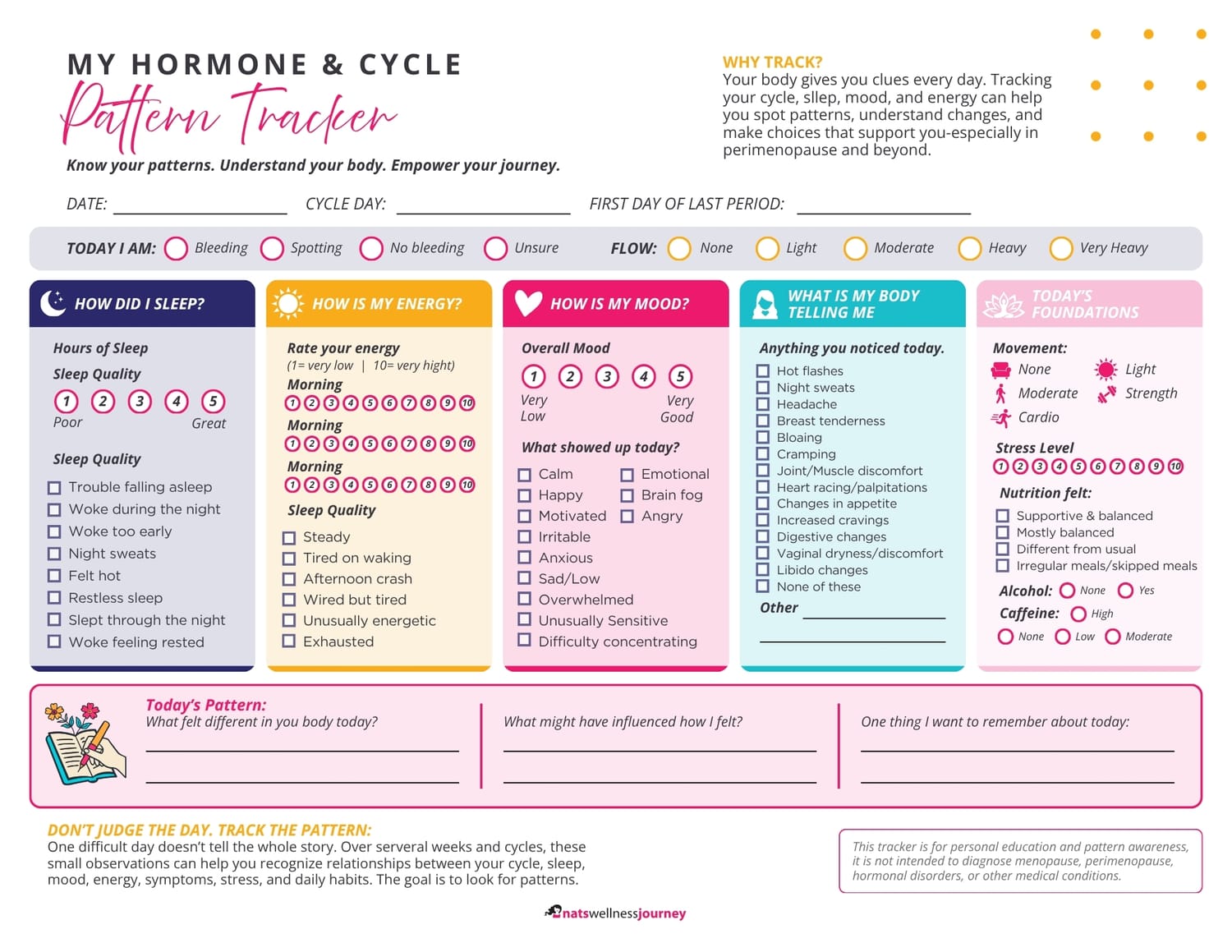
Get your FREE
Hormone & Cycle
Pattern Tracker
Enter your email above, click the button and you will be directed to where you can download the flier.
No spam ever, unsubscribe anytime.
This article is for educational purposes and isn't a substitute for personalized medical advice. Please talk with your doctor about your specific symptoms, health history, and options, including whether hormone therapy or other treatments are appropriate for you.
Sources
Definition of perimenopause and its distinction from menopause: Perimenopause: Age, Stages, Signs, Symptoms & Treatment — Cleveland Clinic
Average age of onset, duration, and stages of perimenopause: Perimenopause Timeline: How Early Can It Start and What To Expect — Allara Health
Hormonal mechanisms: progesterone decline, estrogen fluctuation, and FSH variability: Perimenopause hormones: what changes and why it matters — Needed
Symptom prevalence statistics and consultation rates: Perimenopause symptoms, severity, and healthcare seeking in women in the US — npj Women's Health, Nature
Visceral fat increase and lean mass loss during the menopausal transition: The Impact of the Menopausal Transition on Body Composition and Abdominal Fat Redistribution — PMC
FSH testing reliability and symptom-based diagnosis guidance: Perimenopause Tests: Reliability Issues and Accuracy Explained — Ultrahuman
Lifestyle management strategies (exercise, nutrition, sleep): Perimenopause: Lifestyle Approaches for Maintaining Optimal Health and Wellness — Institute for Functional Medicine
HRT benefits, risks, and 2025 FDA labeling guidance update: Menopausal Hormone Therapy—Risks, Benefits and Emerging Options: A Narrative Review — PMC; FDA update referenced via New FDA Guidance on Hormone Replacement Therapy — SafeMedication

Perimenopause touches everything...
your sleep, your mood, your metabolism, your focus. This simple guide walks through natural, holistic ways to support your body through it: what's actually backed by research, what's just noise, and where to start.
Past Perimenopause?
Click on the one you currently are experiencing.

Menopause is technically a point in time—the completion of 12 consecutive months without a menstrual period—but the transition surrounding it can involve much more than reproductive hormones.
This section can help women understand what is changing and what systems deserve more attention during this stage.

Supporting the Body for the Decades Ahead
Once the menopausal transition is complete, the goal shifts again.
This stage can become less about managing unpredictable hormonal swings and more about protecting long-term metabolic health, strength, mobility, cognition, cardiovascular health, and quality of life.
WANT A LITTLE MORE SUPPORT
Sign Up for A FREE Consultation Today!
This is a complimentary 20-minute call.
I will personally connect with you to understand your needs and see how I can best support you.

Nat's Wellness Journey is a space for approachable wellness education, practical resources, and real-life learning to help women better understand their bodies and make informed choices about their health.
💌 natalie@natswellnessjourney.com
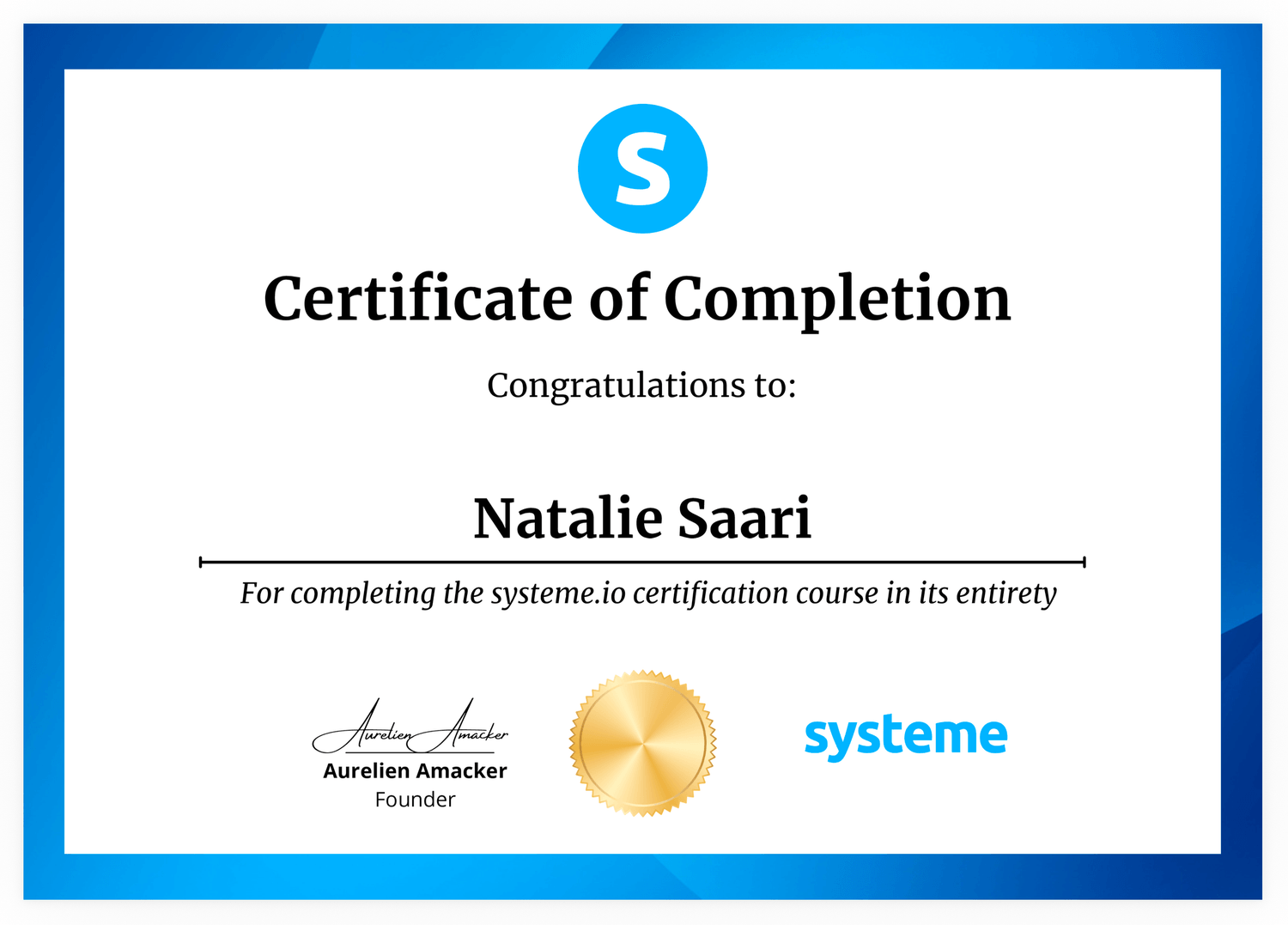
Credential & Certifications





© 2026 Nat's Wellness Journey. All Rights Reserved
Privacy Policy | Terms of Use | Disclosure | Health Disclaimer